Battery usage

This menu option is not displayed on inverters that have been configured as MDC clients. Control is handled by the inverter that has been configured as the MDC host.

If a battery is connected to the inverter, usage of the battery can be configured here.

The following options can be used to optimise battery usage:

Parameter

Explanation

No optimisation

The battery is used as normal for charging and discharging. All other settings should be configured under the battery settings.

Time-controlled battery usage

There are times when the costs of electricity procurement are relatively high (different tariff models). Therefore, it may make sense to allow the battery to discharge during these periods and to allow charging outside of these periods.

The times set here can be overridden by the specifications of an activated external battery management system.

No limitation:
No conditions have been set for this time period.


Battery charging blocked, battery discharge permitted in the event of demand from house:
The battery is not charged in this time period. However, the battery is allowed to discharge if there is demand from the house.

Battery discharge blocked, battery charging permitted in the event of excess power:
The battery is not discharged in this time period. However, the battery is charged as soon as there is excess power available.


NOTE! Note whether the local regulations permit the storage unit to be charged from the public grid. If you are in any doubt, ask your installer.

Battery charging to xxx% SoC with max. xxx W grid demand, battery discharge in the event of demand from house:
The battery is charged in this time period. Energy is obtained from the public grid until the specified SoC value is reached with the set value for grid demand. This may be appropriate if you have a particularly economical grid energy tariff at certain times. However, the battery is allowed to discharge if there is demand from the house.

Battery charging to xxx% SoC with max. xxx W grid demand, no battery discharge in the event of demand from house:
The battery is charged in this time period. Energy is obtained from the public grid until the specified SoC value is reached with the set value for grid demand. This may be appropriate if you have a particularly economical grid energy tariff at certain times. However, the battery is not allowed to discharge if there is demand from the house.

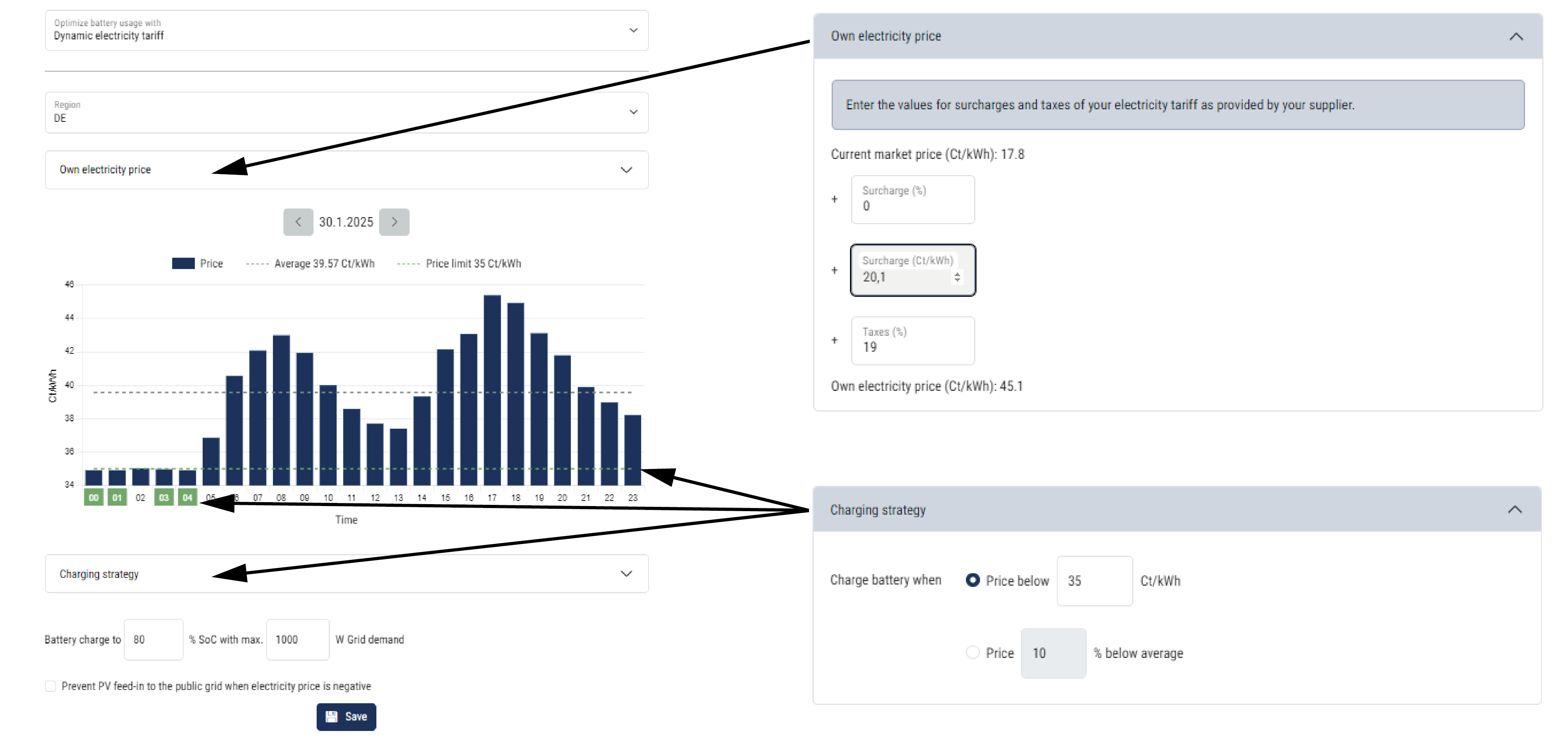
Dynamic electricity tariff

If a dynamic electricity tariff is used, the behaviour regarding battery charging from the grid can be configured here.


Region:
Country selection, e.g. DE for Germany.

Own electricity price:
Enter the surcharges levied by the energy supplier in addition to the exchange electricity price. The surcharges can be entered as a percentage or as a fixed monetary value. Also enter any taxes applicable to the electricity price.
The current total electricity purchase price is then displayed under ‘Own electricity price (Ct/kWh) ’.

Graphical representation of dynamic electricity price:
The graphical representation provides an overview of the current and past electricity prices over the last 7 days.

Charging strategy:
The battery is charged when the set conditions are met. This is the case when the price falls below the fixed set price or deviates by the set percentage from the average electricity price. Domestic consumption is primarily covered by PV output, with the remaining output used to charge the battery. If the conditions for charging under the dynamic electricity tariff are met, the remaining charging power is drawn from the public grid.

Battery charging to:
Set the maximum battery SoC here, up to which the battery should be charged from the grid and at what maximum power. When the conditions are met, the battery is charged according to the settings.

Prevent PV feed-in to the grid when the electricity price is negative:
If the electricity exchange price is negative, as a PV system operator you will generally receive no remuneration for the electricity fed into the grid, or may even have to pay a fee. Activating this function prevents electricity from being fed into the public grid. Please contact your energy supplier to find out the exact terms and conditions.